
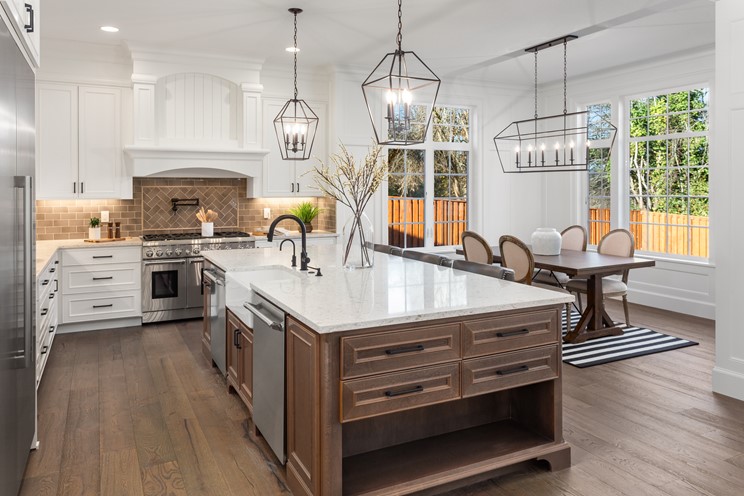
Colorado's dry air is close to the last thing your countertops need protecting from. Wood floors and cabinet doors move with the seasons here, but polished stone and engineered quartz barely register a change in humidity. What actually ages a countertop in the Denver metro is three other things: what you wipe it with, the minerals in your tap water, and the mile-high sun coming through the kitchen window. Marble and quartz each handle those three differently, and the care that keeps one looking new can be beside the point for the other. Here is how to look after both.
Does Colorado's Dry Climate Actually Hurt Marble or Quartz?
Dry air doesn't damage marble or engineered quartz in any meaningful way. Humidity swings warp organic materials like solid wood because wood takes on and gives off moisture, and a long Front Range heating season is genuinely hard on hardwood floors and cabinet doors for that reason. Stone and quartz don't work that way. A marble slab doesn't shrink in January and swell in July, and a quartz top holds its shape in a bone-dry kitchen just as well as in a humid one. If a countertop looks tired in a Colorado home, the dry air didn't do it.
The stressors that do age a countertop here are specific, and two of them are peculiar to this market. Denver Water rates its supply as soft to moderately hard rather than truly hard, so mineral spotting is milder than it would be in a hard-water region, but any dissolved minerals still leave marks when a puddle dries on a dark polished surface. And Denver sits a mile above sea level, where the sun is stronger. The rest comes down to chemistry, and marble and quartz have very different chemistry.
Why Marble Etches, and Why No Sealer Will Stop It
Marble etches because it is mostly calcite, a mineral that reacts with acid on contact. The Natural Stone Institute, the trade body whose care standards most fabricators follow, is blunt about it: lemon juice, vinegar, wine, tomato, and many common cleaners will dull or etch calcareous stones like marble, limestone, and travertine. An etch is not a stain sitting on top of the stone. It is a tiny patch where the acid has eaten into the polished surface and left it rough and dull, which is why it catches the light differently than the marble around it.
Sealing doesn't prevent this, and it is worth being clear about why, because the belief that it does costs people their marble. A sealer, or more precisely an impregnator, soaks in and makes the stone more stain resistant by slowing how fast a spill can penetrate. The Natural Stone Institute states plainly that sealing doesn't make stone stain proof and says nothing about etching, because etching happens at the surface the instant acid touches it, long before anything soaks in. You can seal a marble top on schedule and still etch it with a squeezed lime. The honest way to live with marble is to wipe acidic spills fast, keep a cutting board under citrus and tomato, and accept a soft patina over the years as part of the material's character.
Marble is also soft enough to scratch. On the Mohs scale that geologists use to rank minerals by how easily they scratch, marble's calcite sits at 3, barely above a fingernail at about 2.5, while an ordinary steel knife blade is harder at roughly 4 to 4.5. That gap is the whole story: a knife blade will leave a line on a marble counter, and the same blade slides harmlessly across quartz, which sits up at 7. Granite lands at 6 to 7 as well, which is why it resists a blade where marble surrenders to one. Keep a cutting board between your knife and any marble top.
How Quartz Is Different: Non-Porous, but Not Heatproof
Engineered quartz asks for almost no maintenance because it is non-porous, but it has one real weakness that marble does not: heat. A quartz slab is about 90 to 93 percent ground natural quartz, a crystal that is 99.9 percent silica, bound together with 7 to 10 percent polymer resin, according to the technical description of how engineered stone is made. The quartz is what makes it hard and stain resistant. The resin is a plastic, and a pan straight off a hot burner can scorch or discolor it, or in a bad case crack it from the sudden temperature shock. This is the reason every quartz maker tells you to use trivets, and it is the one habit a marble owner doesn't have to think about, since solid stone shrugs off heat that would mark quartz.
Because quartz is non-porous, it never needs sealing, and acids that etch marble do nothing to it. A splash of lemon juice on quartz wipes away with no mark at all. Day to day, quartz is the more forgiving surface by a wide margin. It rewards a wipe with a soft cloth and a neutral cleaner, and it punishes exactly two things: a hot pan set down bare, and a scouring pad or a harsh cleaner that clouds the polish over time.
The Altitude Problem Nobody Warns You About
High-altitude sun is the one Colorado condition that genuinely affects quartz, and almost no countertop guide mentions it. The EPA measures ultraviolet intensity rising about 6 percent for every kilometer of elevation, and Denver sits a mile up, a bit over one and a half kilometers, so a countertop here takes on the order of 10 percent more UV than the same slab would at the coast. Over years, strong ultraviolet can yellow the polymer resin in some engineered quartz, most visibly on white and pale colors, which is why manufacturers warn against installing quartz in direct, constant sun such as an unshaded south-facing window or an outdoor kitchen.
Natural stone doesn't have this problem. Marble and granite carry no resin to yellow, so a marble top in a sun-drenched Colorado kitchen holds its color where a white quartz might slowly warm in tone. If your kitchen island sits under a big south or west window that gets hammered by afternoon sun, that is a point in favor of natural stone, or a reason to plan for a shade or a UV-filtering window film if your heart is set on a pale quartz. It is a small consideration for most kitchens and a real one for a few, and it is worth raising before the slab is cut rather than after.
Hard Water Spots and Denver's Water
Water spots on a countertop come from the minerals left behind when water evaporates, and Denver's relatively gentle water makes them easy to manage. Denver Water classifies its supply as soft to moderately hard: soft water runs under 60 milligrams of calcium carbonate per liter, and water only counts as hard once it climbs to 121 to 180, which the metro's mountain-fed supply stays below. That lighter mineral load means spots here tend to be faint rather than crusty. They still show up, though, especially on dark granite and dark quartz where a dried droplet leaves a pale ring. The fix is the same for both surfaces and takes seconds: blot spills and splashes dry instead of letting them air-dry, and wipe the counter down after washing up rather than leaving beads of water to evaporate on their own.
On marble, drying up promptly does double duty, since standing water is also how a mineral deposit or a hard-water film builds on calcite over time. A soft cloth and plain water handle daily wiping on any of these surfaces. Save the deep cleaning for a neutral, stone-safe cleaner, and keep the acidic bathroom and glass sprays away from stone entirely.
A Care Routine That Works for Both
The daily routine for marble and quartz is nearly identical, and it is short. The Natural Stone Institute's own advice for stone is a mild dish soap or a neutral stone cleaner with warm water, wiped with a soft cloth, then rinsed and dried, and that same routine keeps quartz looking new too. The differences are only in what each surface cannot tolerate, and they are easy to remember.
- Skip the acid. No vinegar, no lemon, no citrus-based or bathroom cleaners on marble, ever. They are fine to keep off quartz as well, since harsh cleaners dull its polish over time.
- Use trivets on quartz. A hot pan can scorch the resin. Marble takes heat better, but a trivet protects the polish on any surface.
- Cut on a board. Marble scratches from a steel blade; quartz will not, but a board keeps knives sharp and the counter unmarked either way.
- Blot spills fast. On marble it heads off etching and staining; on any surface it prevents water and mineral spots.
- Reseal marble and other porous stone as needed. Sealing slows staining. It won't stop etching, so treat it purely as a stain measure, and let how often you reseal depend on how hard the surface gets used rather than on a fixed schedule.
Marble vs Quartz Care at a Glance
| Care factor | Marble (calcite stone) | Engineered quartz |
|---|---|---|
| Acid etching (lemon, vinegar, wine) | Etches on contact; sealing doesn't prevent it | Not affected |
| Sealing | Needs periodic sealing for stain resistance | Non-porous; never needs sealing |
| Heat from a hot pan | Handles heat well | Resin can scorch; use trivets |
| Scratches from a knife | Softer (Mohs 3); scratches | Hard (Mohs 7); resists scratches |
| Strong direct sun (altitude UV) | Holds color; no resin to yellow | Pale colors can yellow over years |
| Daily cleaning | Neutral cleaner, soft cloth, dry it | Neutral cleaner, soft cloth, dry it |
Questions We Get About Marble and Quartz Care in Colorado
Does dry Colorado air crack countertops?
No. Dry air doesn't crack marble or quartz. Both hold their shape regardless of indoor humidity, unlike solid wood, which does move with the seasons. Cracks in a countertop almost always trace to something structural, such as an unsupported overhang, a seam under stress, or a cabinet run that was not level when the top went on, rather than to the climate.
Do I need to seal my quartz countertop?
No. Engineered quartz is non-porous, so a sealer has nothing to soak into and would just sit on the surface. Sealing is a marble and granite concern, where the stone is porous enough that an impregnator slows staining. Quartz only needs a wipe with a neutral cleaner.
Will one splash of lemon juice ruin my marble?
One quick splash wiped up right away usually does no harm, but acid left to sit will etch a dull mark into marble within minutes. The risk is real enough that a cutting board under anything acidic, and a fast wipe of any spill, is the difference between marble that keeps its shine and marble that develops cloudy patches near the sink and stove.
Can I set a hot pan on quartz?
Not safely. The polymer resin that binds engineered quartz can scorch or discolor under a pan straight off the burner, and a sudden temperature change can crack it. Keep a trivet or a hot pad within reach of the stove. Solid stone like granite and marble tolerates heat far better, though a trivet is still cheap insurance.
Which is lower maintenance overall, marble or quartz?
Quartz, by a wide margin. It never needs sealing, shrugs off acids, and resists scratches, so daily care is just a wipe. Marble is the more demanding surface: it rewards careful owners with a look nothing else matches, and it asks for fast spill cleanup, acid avoidance, and periodic sealing in return. Neither is hurt by Colorado's dry air.
Choosing the Right Surface for Your Kitchen
The best countertop for a Colorado kitchen is the one whose care habits match how you actually cook and live, and both marble and quartz can be the right call depending on the room. If you want a surface you rarely think about, quartz is the easier partner, as long as it stays out of relentless direct sun. If you love the look of natural stone and don't mind a patina, marble and the other natural options each have their own strengths, and you can compare them side by side in our guide to quartz versus natural stone for Castle Rock kitchens. When you are ready to see and feel real slabs, you can browse the natural stone we carry, and when you want a hand narrowing it down, request a free estimate and we will talk through your kitchen, your habits, and how much sun that island really gets.