
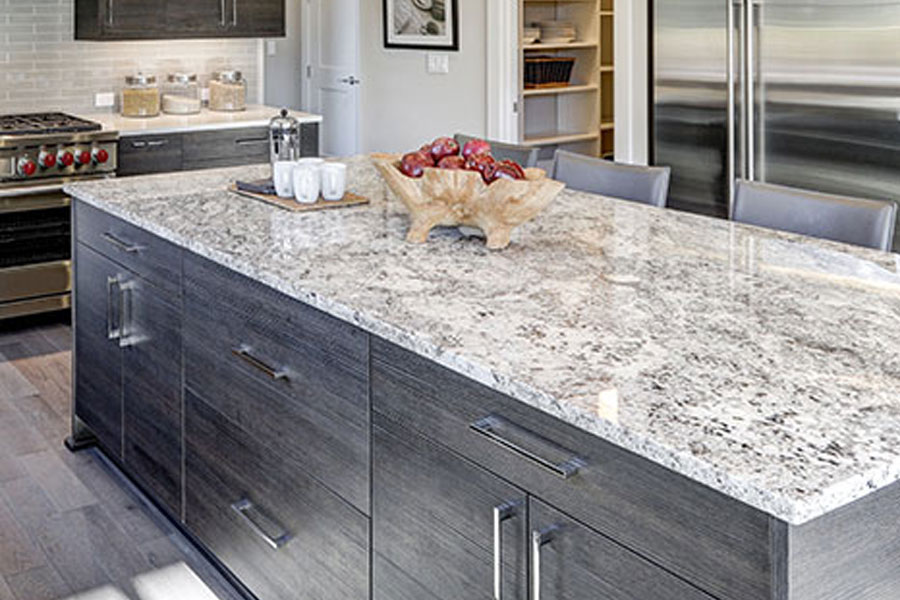
A steel kitchen knife is hard enough to scratch marble and nowhere near hard enough to touch granite, quartz, or quartzite. That one fact does more to sort out countertop choices than any showroom pitch, because the differences that matter in a Castle Rock kitchen come down to four physical properties: hardness, porosity, heat tolerance, and how each surface reacts to acid. Engineered quartz and the natural stones each land differently on those four, and there's no single winner. The right countertop is the one whose strengths match how you cook and how much upkeep you want to sign up for. Here's how quartz, granite, marble, and quartzite compare, measured against the standards that actually define them.
What Is the Real Difference Between Quartz and Natural Stone?
The core difference is that engineered quartz is manufactured while granite, marble, and quartzite are quarried. A quartz slab is about 90 to 93 percent ground natural quartz, a mineral that is 99.9 percent silica, blended with 7 to 10 percent polymer resin and pressed into a slab, which is the description used for how engineered stone is made. That resin binder is why quartz comes out non-porous and consistent in color from slab to slab. Natural stone is the opposite story: each slab is cut from the earth, so it carries unique veining, it is porous to some degree, and no two pieces are identical. Neither approach is better in the abstract. They simply behave differently once they are in your kitchen.
The manufacturing gap between quartz and natural stone drives almost everything else. Because quartz is non-porous, it never needs sealing and resists stains without help. Because natural stone is porous, it takes a sealer to slow staining and shows more of the character that draws people to it in the first place. Quartz trades a little of that natural character for lower maintenance, and natural stone trades a little convenience for a look no factory can reproduce.
Is Quartzite the Same as Quartz?
No, and the names cause real confusion at the showroom. Quartzite is a natural stone, a metamorphic rock formed when sandstone is squeezed and heated underground until its grains fuse, and it is made mostly of the mineral quartz. Engineered quartz is a manufactured product that also relies on quartz but binds it with resin. They share a mineral and a syllable, and that is where the resemblance ends.
The practical difference matters when you are choosing. Both are hard, sitting near 7 on the Mohs hardness scale that geologists use to rank minerals by scratch resistance, so both shrug off knives. But quartzite is natural stone, which means it is porous and wants periodic sealing, and it handles heat well because it has no resin to scorch. Engineered quartz is the reverse: non-porous and sealing-free, but vulnerable to a hot pan. If a fabricator or a slab yard uses the two words loosely, ask which one they mean, because the care is different for each.
Which Countertop Resists Scratches Best?
Quartz, granite, and quartzite all resist scratches far better than marble, and the Mohs hardness scale shows why in plain numbers. The scale runs from talc at 1 to diamond at 10; a fingernail scratches only up to about 2.5, and an ordinary steel knife blade lands around 4 to 4.5. Engineered quartz and quartzite sit up at about 7, and granite ranks 6 to 7, all comfortably above steel, so a dropped knife or a dragged pan leaves them unmarked. Marble is the outlier: it is mostly calcite, which sits at just 3 on the scale (some references put it at 3 to 4), softer even than some coins, which is why a marble counter picks up fine scratches over the years of any busy kitchen.
Marble's softness doesn't rule it out. Plenty of homeowners love the way marble ages into a soft, lived-in patina, and a light-use kitchen or a baking station can suit it beautifully. But for a household that cooks hard, cuts often, and would rather not think about the surface, the harder materials are the safer call. Cutting on a board protects any countertop and keeps your knives sharp on top of it.
Which Countertops Need Sealing, and Which Ones Etch?
Every natural stone here wants periodic sealing, and only marble truly etches. The Natural Stone Institute, the trade body whose care standards most fabricators follow, explains that stone sealers are really impregnators that soak in and repel stains rather than forming a coating, so granite, marble, and quartzite all benefit from resealing on a schedule that depends on use. Engineered quartz skips this entirely because it is non-porous. There is nothing for a sealer to soak into.
Etching is a separate problem, and it belongs almost entirely to marble. Etching is a dull spot where acid has chemically eaten the polished surface, and the Natural Stone Institute is direct that lemon juice, vinegar, wine, and similar acids will etch calcite-based stones like marble on contact. The part that surprises people is that sealing does not prevent it, because a sealer guards against staining and says nothing about the acid reaction that happens at the surface in an instant. Granite and quartzite are far more acid-tolerant than marble, and quartz is fully acid-proof. If you love marble and cook with a lot of citrus and tomato, a cutting board and fast spill cleanup are the price of keeping its shine.
Heat, and the One Thing Quartz Can't Do
Natural stone handles heat better than engineered quartz, and it is the clearest trade-off in the whole comparison. Granite, marble, and quartzite come out of the ground and tolerate a hot pan far better than the polymer resin that binds a quartz slab, which can scorch, discolor, or crack from the thermal shock of cookware straight off the burner. Every quartz maker tells you to use trivets for this reason. It is a small habit, but it is a real limit, and it is the main thing a natural-stone owner does not have to manage. If you routinely move pans from stove to counter without thinking, that is a genuine point in favor of granite or quartzite.
Do Granite Countertops Give Off Radon?
Granite countertops are not a meaningful radon or radiation risk, according to the EPA. The U.S. Environmental Protection Agency, the federal agency that sets the country's radiation guidance, states that it is extremely unlikely radiation from granite countertops would raise a home's radiation above normal background levels, and that radon coming up from the soil beneath a house is a far larger public health concern than anything from a countertop. This scare circulates every few years, and it keeps some buyers away from a beautiful, durable stone for no good reason.
The sensible takeaway is to test the house rather than avoid the countertop. The EPA recommends that every home be tested for radon and mitigated if levels are high, whether or not it has granite, because the soil is the source that actually matters. Radon testing is cheap and worth doing in Colorado regardless of your kitchen, and a granite slab should not be the thing that decides it either way.
Quartz vs Granite vs Marble vs Quartzite
| Property | Engineered quartz | Granite | Marble | Quartzite |
|---|---|---|---|---|
| Type | Manufactured (90-93% quartz + resin) | Natural stone | Natural stone | Natural stone |
| Hardness (Mohs) | About 7 | 6 to 7 | About 3 (soft) | About 7 |
| Porous / needs sealing | Non-porous; never | Porous; periodic | Porous; periodic | Porous; periodic |
| Acid etching | None | Very resistant | Etches easily | Very resistant |
| Heat tolerance | Low; use trivets | High | High | High |
| Look | Uniform, consistent | Varied, speckled | Dramatic veining | Natural, often veined |
Which Countertop Is Right for a Castle Rock Kitchen?
The best choice depends on how your household actually uses the kitchen, and each material has a clear sweet spot. For a busy family kitchen where the counter takes a beating and nobody wants a maintenance schedule, engineered quartz is the easy pick, as long as everyone learns to reach for a trivet. For a cook who wants natural stone with real toughness, quartzite delivers the hardness of quartz with the heat tolerance of stone, asking only for periodic sealing in return. Granite splits the difference: it is hard, heat-proof, acid-tolerant, widely available, and the radon worry is a myth. Marble is the showpiece, unmatched for drama and worth its upkeep to the right owner, but it is the wrong surface for a household that cooks hard and cuts often.
Castle Rock's dry, high-altitude climate barely factors into this decision, since stone and quartz are stable in dry air, though pale engineered quartz is worth keeping out of an unshaded, sun-blasted window over the years. The bigger question is always how you cook and how much upkeep you want. Seeing and touching real slabs settles it faster than any chart, and you can start by browsing the natural stone we carry. If you have narrowed it to marble or quartz, our guide to caring for marble and quartz in Colorado's climate covers the day-to-day of living with each.
Questions We Get About Quartz and Natural Stone
Is quartz better than granite?
Neither is better outright; they trade strengths. Quartz is non-porous, never needs sealing, and is fully acid-proof, but its resin binder means a hot pan can damage it. Granite is a natural stone that handles heat beautifully and resists acids well, but it is porous and wants periodic sealing. A busy, low-maintenance kitchen leans quartz; a serious cook who sets down hot pans leans granite.
Does quartzite need to be sealed?
Yes. Quartzite is a natural stone and is porous, so it takes a periodic impregnating sealer to slow staining, on a schedule that depends on how hard the surface is used. That is one of the main ways it differs from engineered quartz, which is non-porous and never needs sealing despite the similar name.
Will marble countertops etch in a kitchen?
Yes, marble etches when acids touch it, because it is made of calcite that reacts with lemon juice, vinegar, wine, and tomato on contact. Sealing does not prevent etching, only staining. Marble can absolutely work in a kitchen for an owner who wipes spills fast, uses cutting boards, and accepts a soft patina over time, but it asks for more care than the other three surfaces.
Are granite countertops radioactive or dangerous?
No. Granite countertops are not a meaningful health risk. The EPA says it is extremely unlikely that radiation from granite countertops would raise a home's radiation above normal background levels, and that soil is a far bigger radon source than any building material. The right response is to test your home for radon and fix it if the level reaches the EPA's action threshold of 4 picocuries per liter, which every Colorado home should check regardless of its countertops.
Which countertop lasts the longest?
All four last for decades when cared for properly, so longevity comes down to matching the material to the household. Quartz, granite, and quartzite resist scratches and everyday wear at a hardness near 6 to 7, so they stay looking new with little effort. Marble lasts just as long physically but shows its age as etching and fine scratches, which some owners prize as patina and others see as wear.
Choosing Your Countertop with Confidence
The right countertop for your Castle Rock kitchen is the one whose trade-offs you are happy to live with, and once you see the four side by side, the choice usually makes itself. Bring how you cook, how much upkeep you want, and the look you are after, and the material follows. When you are ready to compare real slabs and get a straight answer for your kitchen, request a free estimate and we will walk the options with you, from the hardest-wearing quartz to the most dramatic marble.