
Every kitchen cabinet door is either a frame of four pieces around a center panel or one flat slab. Shaker, raised panel, beadboard and glass doors are all versions of the framed door, and the slab door carries the modern look. The style you pick sets how the kitchen reads, how easily the doors wipe clean and how a painted finish ages in our dry air.
| Door style | What it looks like | Suits | Cleaning |
|---|---|---|---|
| Shaker | Square frame, flat recessed panel | Transitional, farmhouse, modern | Easy; wipe the inside corners |
| Slab | One flat piece, no frame | Modern, minimal | Easiest; one pass |
| Raised panel | Shaped panel standing proud | Traditional, formal, rustic | Most profile to wipe |
| Beadboard | Frame around a grooved panel | Farmhouse, cottage | Grooves hold grease |
| Glass front | Frame around glass | Display uppers | Both sides of the glass |
How a Cabinet Door Is Built
A five-piece cabinet door is two vertical stiles and two horizontal rails joined around a center panel that sits in a groove. A slab door is a single piece. That difference decides how a door looks up close, how it takes paint and how it moves through the seasons.
Most five-piece doors are joined with cope-and-tenon joints, where the rail ends are shaped to lock into the stiles, then glued and pinned. Mitered doors meet at 45-degree corners like a picture frame and read a little more formal.
Slab doors are wood veneer over a stable core with banded edges, or solid MDF, a dense fiberboard made for paint. Some MDF doors are routed from a single piece to look like a five-piece door, which gives the framed look with no joints.
How the door sits on the cabinet is a separate choice from its style. Overlay doors cover the cabinet's face frame, while inset doors sit flush inside it, and either kind can be Shaker, slab or raised panel.
Wood, MDF and Paint Under Each Style
If you want painted doors, the door is usually maple or MDF; if you want stained doors, the species becomes part of the look. Wellborn, one of the cabinet brands we carry, builds its wood doors in cherry, maple, oak and hickory, with maple as the base price; maple, oak and hickory carry no species upcharge, while cherry does.
Maple has a tight, smooth grain that disappears under paint, which is why it's the painted-door wood. MDF is even smoother and doesn't swell and shrink like solid wood, so it makes a stable center panel under paint; when painted maple is ordered, Wellborn switches the center panel to MDF. Oak and hickory have open, strong grain that shows through stain and, unless it's filled, through paint too.
Pick the species with the style. A Shaker door works in any of them. A raised panel looks best in a stained wood, or in a one-piece MDF door with a raised-panel shape if you want it painted. A slab door shows its veneer grain the most, so choose a species whose grain you like across a whole wall.
Shaker Cabinet Doors
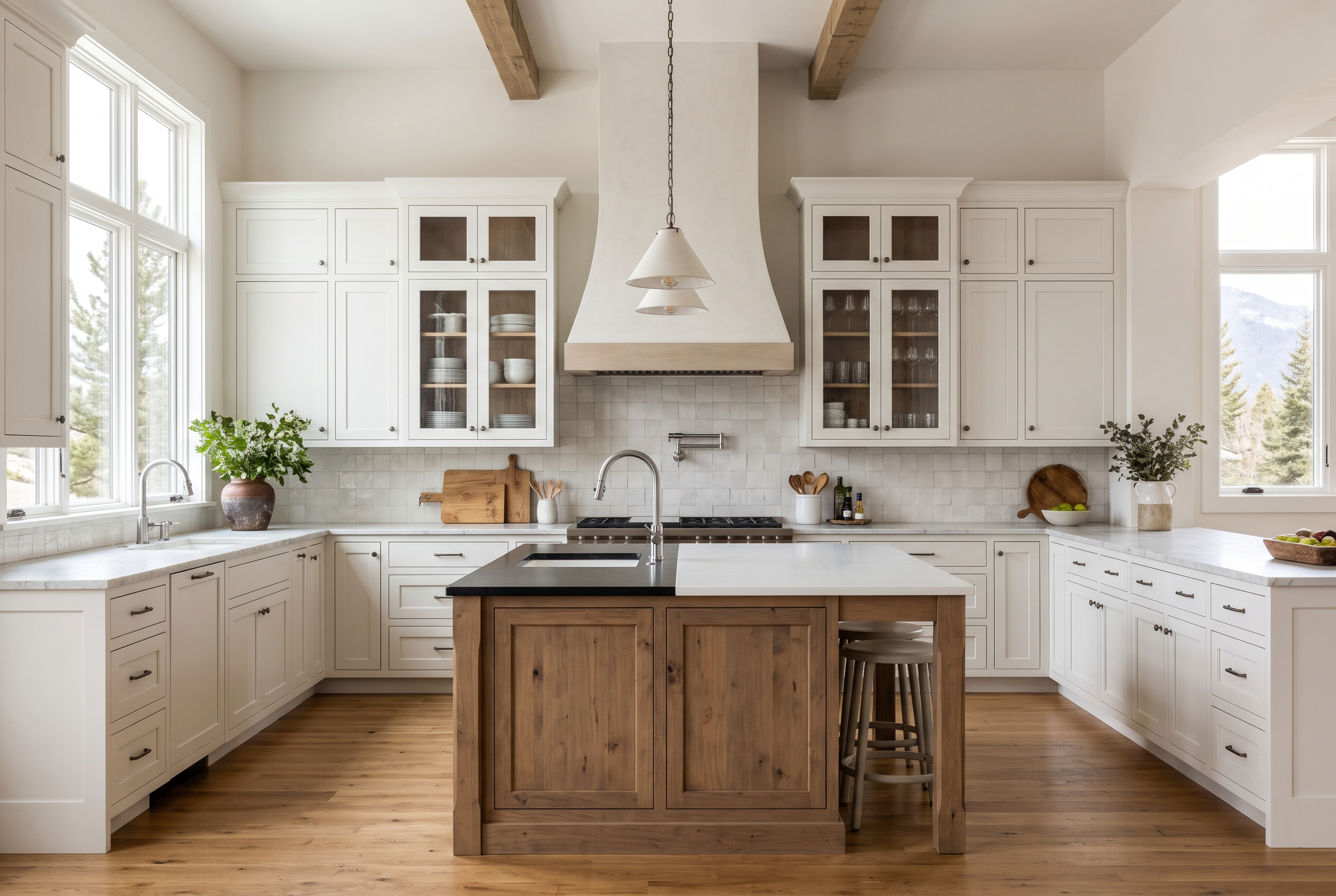
A Shaker door is a five-piece door with square inside edges and a flat, recessed center panel, with no carving or molding. It has been the go-to door in American kitchens for years, because it has nothing on it to date it and it sits as comfortably in a farmhouse kitchen as in a modern one.
A Shaker door's proportions change its character. A standard Shaker has stiles and rails around 2 1/4 inches wide. A slim Shaker narrows the frame to read more modern, and a wide-rail Shaker leans traditional. Some versions add a small bead or bevel on the inside edge.
Drawer fronts follow the doors, with one practical limit. A short top drawer can't fit a frame and a panel, so on Wellborn's five-piece styles, drawer fronts under about 5 3/8 inches tall are made as slabs, while deeper drawers get the full five-piece front. Many Shaker kitchens use slab fronts on every drawer for a cleaner line.
Hardware sits on the frame, never on the panel. Knobs on Shaker doors usually go on the stile opposite the hinges, a couple of inches from the corner; pulls on drawers are centered, and wide drawers often take two pulls or one long one.
A Shaker door wipes clean easily, and the only spot that collects dust and grease is the inside corner where the panel meets the frame; a damp cloth run along it handles that. It takes paint or stain equally well, and it's usually among the least expensive doors in a line. Shaker suits the transitional and modern-farmhouse kitchens common in newer Castle Rock and Parker homes, and it's the safe choice if you want a kitchen that still looks right in fifteen years.
Slab Cabinet Doors
A slab door is a single flat panel with no frame, usually wood veneer over a stable core or painted MDF. It's the door of modern and European-style kitchens, and it's the easiest door there is to keep clean, because there's no edge or corner for anything to collect in.
Slab doors look best when the gaps between them are tight and even, so they're often paired with frameless cabinets and full-overlay doors that cover the whole cabinet face. Veneer slabs show the wood grain. They're banded at the edges and usually stained, the grain won't match from door to door unless the line offers matched grain, and drawer fronts can often be ordered with the grain running sideways for a long horizontal line.
Slab doors pair with long bar pulls, edge pulls or no visible hardware at all. For a handleless kitchen, touch-to-open hardware is an option, and on upper cabinets lift-up doors remove the swing path and suit the clean horizontal lines of a slab kitchen.
Painted slab edges show wear first on drawers that get bumped by knees and toes, so a satin finish and a slightly softened edge help. Solid wood slab doors can cup as the seasons change, so most slab doors are veneer or MDF over a stable core.
Between Shaker and slab, the trade is warmth against sleekness. Shaker's frame adds shadow lines that read warm and familiar, while slab reads clean and quiet and lets a bold countertop or a wood grain do the talking. Slab doors wipe in one pass, and a veneered slab usually prices a little above the simplest recessed-panel doors.
Raised Panel Doors
A raised panel door is a five-piece door whose center panel is shaped, thicker in the middle and beveled toward the frame, so it stands proud of the stiles and rails. It's the traditional door, and arched or cathedral tops on the upper doors make it more formal still.
Is it outdated? In a modern or transitional house, a raised panel door usually reads dated. In a traditional home, or in a rustic mountain-style kitchen in knotty or stained wood, it's at home and looks like it belongs. The house decides that more than the year does.
The shaped profile takes more effort to clean, and on a glazed finish the glaze collects in the profile and corners on purpose, which is part of the look. Raised panels cost more, too, because they sit in a cabinet line's higher price groups, and arched upper doors add to that.
Shaker and raised panel are both five-piece doors, so the difference is the panel. Shaker's panel is flat and set back, which reads simple and casts one clean shadow line; a raised panel is shaped and stands forward, which reads formal and catches light across its bevels. Shaker cleans faster and costs less in most lines, and a raised panel gives a traditional room the detail it expects.
If you love the raised-panel shape but want paint, a one-piece MDF door routed with a raised-panel profile gives you the look without joints to show. In stain, cherry and hickory suit a raised panel best, and around here those doors fit older traditional homes and the rustic homes out toward Franktown and Elizabeth.
Beadboard, Glass-Front and Other Door Styles
Beyond the three main styles, accent doors usually go on part of a kitchen rather than all of it: beadboard on an island, glass on a few uppers, louvers on a pantry.
Beadboard Doors
A beadboard door is a five-piece door whose center panel is grooved to look like cottage wall paneling. It suits farmhouse and coastal kitchens, and it's a good way to set an island apart from the perimeter cabinets.
The grooves are its weakness near a range, because they catch grease and need a soft brush to clean. On a glazed finish, the grooves hold more glaze and come out darker, so look at a glazed sample before you order.
Use beadboard where it's seen but not splattered: an island, a pantry, a laundry room or a coffee bar.
Glass-Front and Mullion Doors
A glass-front door is a frame around glass instead of a wood panel, and a mullion door divides the glass into smaller panes. Glass lightens a wall of uppers and shows off dishes, so it works best on a few upper cabinets beside a window or flanking a hood.
Put the glass on the uppers. Wellborn's glass inserts are non-tempered, and it doesn't recommend them for base cabinets or near interior and exterior doors, where a knee, a toy or a swinging door could break them. That's the answer for a house with small children, too.
Whatever is behind the glass is part of the design, so plan neat shelves, consider lighting inside, and choose seeded, reeded or frosted glass if you'd rather blur the contents. Glass needs cleaning on both sides.
Mission, Louvered and Other Accent Doors
A Mission door is a close cousin of Shaker with a wider bottom rail, which gives it a sturdier, Craftsman look that suits Arts and Crafts homes. A louvered door has angled slats in the frame and belongs on a pantry, a laundry cabinet or anywhere air should move.
Both work as accents rather than a whole kitchen. Louvers collect dust, so keep them out of the cooking zone and use them where their look earns the extra cleaning.
Why Painted Shaker Doors Show Lines at the Joints
A fine line where the rail meets the stile on a painted five-piece door is the wood moving under one continuous coat of paint, and Wellborn treats it as normal. Its guidance explains that solid wood swells and shrinks with humidity and temperature, which creates white lines around center panels and visible cracks in the finish at the joints of painted wood. It calls those joint lines part of the beauty of painted finishes on natural wood.
Our winters make the lines show sooner. Wellborn puts the ideal indoor humidity at 40 to 45 percent and notes that homes range from 20 to 70 percent through the year. A Colorado house with the furnace running in January sits near the dry end of that range, and dry air pulls moisture out of wood and can open hairline cracks in paint.
If you want a painted kitchen with no joint lines, choose a door with no joints to show. A slab door, or a one-piece MDF door routed to look like a Shaker, gives the painted look without joints. A five-piece door with an MDF center panel avoids the white line around the panel. A stained or glazed finish hides movement better than a solid paint color.
If the lines appear, nothing is failing. Keeping indoor humidity steady near 40 percent with a whole-house humidifier slows the movement, and a small touch-up blends a line that bothers you. On a stained door, the same movement shows as a thin pale stripe at the edge of the center panel in winter, and it closes again in summer.
How to Choose a Door Style for Your Kitchen
To choose a door style, start with the house, then think about how your household uses the kitchen, then look at the counters and the rest of the room. Each step rules out a style or two, and what's left is usually an easy choice.
Matching the Door to Your House and Kitchen Size
If your home is a newer transitional or modern-farmhouse build, Shaker or slim Shaker fits; a modern home wants slab; a traditional or rustic home suits raised panel or a wide-rail Shaker in stained wood. The door should look like it belongs to the house, not to a showroom.
In a small kitchen, plain door faces, lighter colors and fewer lines make the room feel larger, and a few glass uppers open up a wall. Busy profiles and dark colors in a small room close it in.
If you'll sell within a few years, a plain Shaker suits the widest range of houses. In a modern house, a well-done slab kitchen sells just as well, so resale is a reason to stay with the house's style rather than a reason to choose Shaker everywhere.
Door Styles for a Busy, Hard-Working Kitchen
In a busy kitchen with heavy cooking or small children, slab door styles are the easiest to keep clean, Shaker is close behind, and raised panel and beadboard take the most work. The finish matters as much as the style: satin paint hides fingerprints better than gloss, and very dark painted slabs show every smudge.
The drawers and doors beside the range, the sink and the trash pull-out take the most handling and splashing. A tougher finish, a slightly softened edge and hardware that keeps hands off the paint protect them.
Glass and beadboard belong away from the busiest zone, on an island end or a set of display uppers, where they're seen more than they're touched.
Mixing Door Styles and Pairing Them With Your Counters
Mixing door styles works when one style leads and the other supports it. A stained Shaker island under a painted Shaker perimeter, slab uppers over Shaker bases, or glass doors on two uppers all read as planned, because they share proportions. Two strongly different styles at equal weight read as two kitchens.
Look at the countertop at the same time as the doors. A slab with bold veining wants a quiet door, and keeping doors simple and finishes calm lets the eye land on the stone. A quiet quartz can take a door with more profile.
In a two-tone kitchen, matching undertones first and then playing with contrast keeps the colors from fighting each other.
What Door Style Does to Cabinet Cost
Within one cabinet line, the door style sets the price group, so the same cabinet box costs more with a fancier door. Wellborn assigns each of its door styles to a price column: its simple recessed-panel doors sit in the lowest columns, its veneered slab and one-piece MDF doors in the middle, and its solid-wood raised-panel and mitered doors in the highest. Wood species and finish move the price again.
If your cabinet boxes are sound, new doors on the old boxes change the style for much less than new cabinets. Nationally, refacing, meaning new doors and drawer fronts plus a veneer over the cabinet boxes, runs about $150 to $450 per linear foot, with $7,230 the average project in HomeAdvisor's survey of completed jobs. Fixr puts refacing at about $435 per door on average, with thermofoil doors at the low end, wood veneer in the middle and solid wood at the top.
| Option | National range | What changes |
|---|---|---|
| Refinish existing doors | $1,800 to $4,200 | Color only; same style |
| Reface | $150 to $450 per linear foot | New doors, fronts and veneer |
| New cabinets | $100 to $1,200 per linear foot | Boxes, layout and doors |
Refacing makes sense when the cabinet boxes are level, sturdy and free of moisture damage and the layout already works. We price your doors and cabinets at the estimate, because the line, the style and the finish together set the number. If you'd rather spread the cost over the project, we offer financing.
Fixing Common Cabinet Door Problems
A cabinet door that sits crooked or rubs its neighbor is the most common door problem, and it's usually a two-minute fix. Most modern doors hang on concealed hinges with adjustment screws.
- Open the door and find the adjustment screws on the hinge arm inside the cabinet.
- Turn the side-adjustment screw to move the door left or right until the gap with its neighbor is even.
- Turn the depth screw to move the door in or out until it closes flush with the cabinet face.
- Loosen the mounting-plate screws to slide the door up or down, then retighten them.
- Adjust both hinges the same amount, a quarter turn at a time, and check the gap after each turn.
A fine line at a painted joint, or a pale stripe at a stained panel's edge in winter, is wood movement and eases when the humidity is steady. A chip on a painted edge is touched up with paint in the cabinet's exact color, so ask for a touch-up in the finish's name when the cabinets are ordered.
A door that has warped is a different matter, usually the result of a leak or of very dry or damp conditions, and the paperwork that comes with your cabinets decides how it's handled. A rattling glass panel usually needs its retainer clips tightened or replaced.
Choosing Cabinet Doors With Us
At Gracefully Framed, we help you choose cabinet doors from the lines we carry and design the kitchen around them. Across our cabinet brands there are dozens of door styles, including several Shaker-style doors in different proportions, and each line covers the range in its own way.
Wellborn offers a wide selection of door styles, finishes and wood species, in framed and frameless cabinets. Skyline Cabinetry's styles balance classic proportions with layered stain and paint finishes. DeWils adds hand-applied finishes and custom options, and CNC Cabinetry rounds out the range.
Once the doors are chosen, our team installs the cabinets, makes sure every door is aligned and walks through the finished kitchen with you. Our office sits on Jerry Street in Castle Rock, and we design kitchens for homes across the Denver metro, from Highlands Ranch and Littleton to Parker, Elizabeth and Franktown.
Questions People Ask About Cabinet Door Styles
Do Shaker Cabinets Go Out of Style?
No, the plain Shaker door has stayed current for decades because it has no ornament to date it. What dates a Shaker kitchen is usually the finish, the color and the hardware, all of which can change around the same doors.
To keep a Shaker kitchen current, choose a proportion that suits the house, slim for modern and standard or wide for traditional, and let paint colors and pulls carry the trends.
How Can I See a Door Style Before I Order?
Look at a full-size door in your own light before you order. Color shifts with lighting, profiles and edges, and a small chip can't show how a raised panel or a beadboard groove catches the light.
To compare styles quickly, try a slab door against a Shaker one on a kitchen in our visualizer, then narrow it to two or three doors to see in person.
Can You Paint Stained Cabinet Doors?
Yes, stained cabinet doors can be painted with the right preparation: a thorough degreasing, a light scuff-sanding, a bonding primer and a cabinet-grade enamel. Paint over a slick stained finish without that prep tends to peel at the edges, where hands and towels rub it.
Two things change once they're painted. Five-piece doors can start to show the joint lines that paint makes visible, and open-grained oak shows its grain through paint unless the grain is filled first.
See the Doors in Your Own Light
A door style is easiest to choose standing in your own kitchen, next to your floor and your window. When you're ready, one of our project specialists will meet with you, look at your kitchen and price the doors you're drawn to.

