

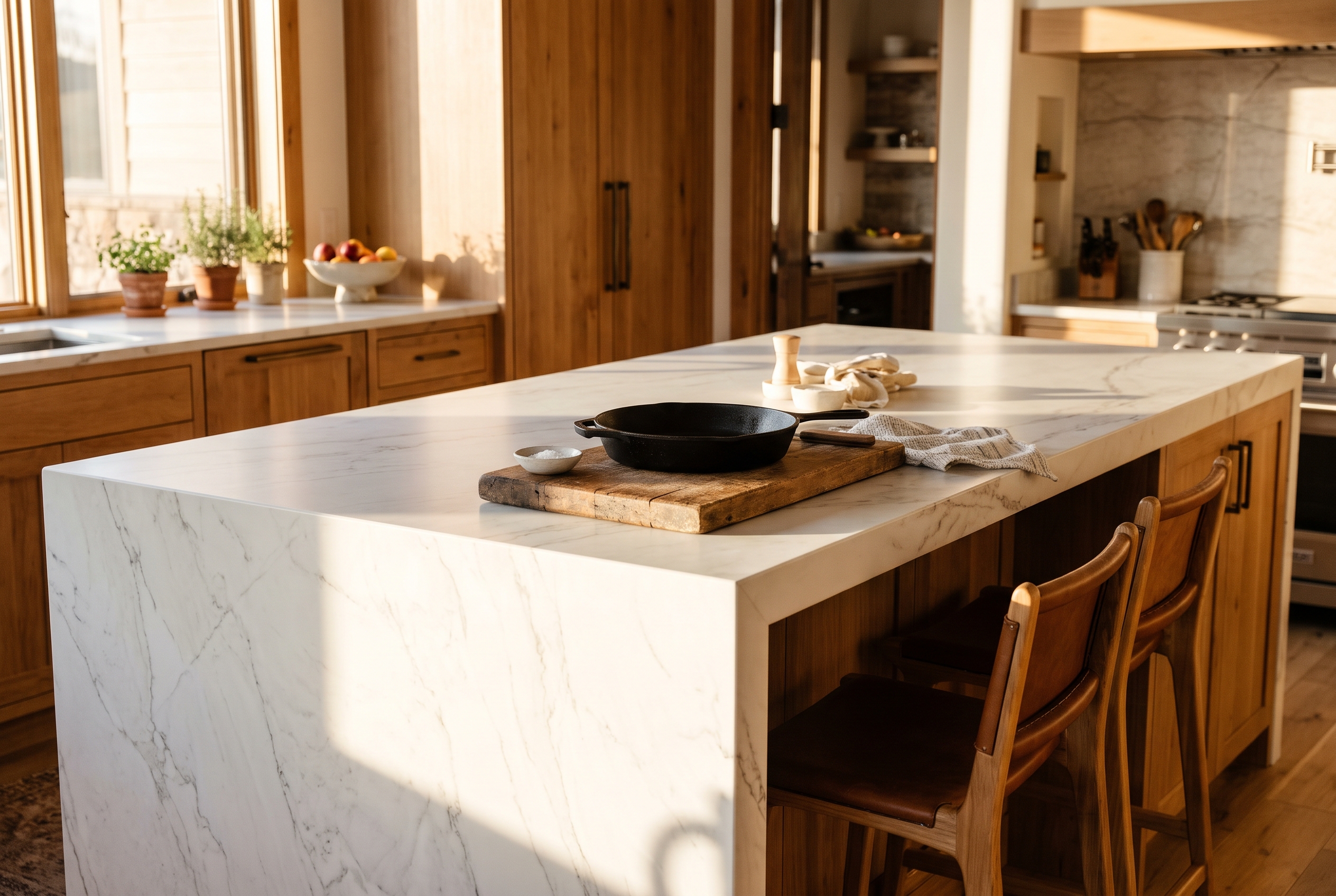
Porcelain is the countertop for a kitchen that gets hot pans, red wine and strong afternoon sun, because almost nothing soaks into it, scorches it or fades it, and it never needs sealing. The trade is at the edges. A thin, very hard slab can chip where a heavy pot catches a corner, and on most slabs the pattern sits on the face, so the edge and the slab get chosen together.
| Everyday question | Porcelain | Quartz | Granite |
|---|---|---|---|
| A hot pan off the stove | Takes it | Trivet, per its makers | Takes it |
| Strong sun or outdoors | Colorfast, rated for outdoors | Mostly indoors; resin can yellow | Holds color; seal it |
| Stains and sealing | Never sealed | Never sealed | Sealed periodically |
| A hard knock at the edge | Can chip; plan the edge | Can chip at sinks | Can chip; fills blend in |
| Edge shapes | Eased or mitered | Most profiles | Any common profile |
| Installed cost, nationally | $50 to $70 a sq ft | $50 to $200 a sq ft | $50 to $200 a sq ft |
What Porcelain Countertops Are
A porcelain countertop is a large slab of refined clay and minerals, pressed and fired at very high heat until it's dense enough to absorb almost no water. That density is what makes it porcelain. The Tile Council of North America (TCNA) defines porcelain by water absorption of 0.5 percent or less, and nearly every strength it has on a counter traces back to that number.
Today's porcelain counters aren't the tiled counters with grout lines that some older kitchens still have. They're cut from sheets as big as about 10 feet by 5 feet, so a full run of counter or an island can be one piece. You'll hear them called porcelain slabs or large-format porcelain panels, and it's the same material either way.
The look gets onto the slab in one of two ways. Most slabs carry their marble veining or concrete texture as a high-definition print on the face of the slab. A smaller group is colored all the way through. Which kind you choose decides the edges a slab can take and what a chip would look like, so it's worth knowing before you fall for a pattern.
Where Porcelain Outperforms Other Countertops
The pros of porcelain all show up on the face of the counter, in the heat, stains, sun and scratches a kitchen puts it through every day. On each of them, porcelain does better than quartz and most natural stone. It was fired far hotter than any kitchen gets, it has no resin binder to scorch or yellow, and it has no pores for a spill to sink into.
Hot Pans and Heat
A pot straight off a burner won't scorch, melt or discolor a porcelain counter, because there's no resin in it to soften. Stratus Surfaces, whose porcelain slabs we carry, describes them as completely resistant to heat. That's the clearest practical difference between porcelain and quartz.
Heat resistance matters most where hot things land without a second thought. Think of the counter beside the range, the spot where a sheet pan comes out of the oven, and the corner where the air fryer or slow cooker lives. On porcelain, none of those spots needs a permanent trivet.
The cooktop area still asks more of a counter than heat resistance alone. Steam rising into the upper cabinets, the cabinetry under the cooktop and tight clearances at the cutout all shape that zone, and the counter is one part of planning it.
We'd still keep a board or a trivet by the range, mostly for the pans. A cast-iron or aluminum pan slid across porcelain can leave gray metal marks, and grit trapped under a pan is about the only thing that can scuff a surface this hard.
Stains, Spills and Sealing
Red wine, coffee, turmeric and cooking oil wipe off porcelain, because almost nothing can soak into it. It never needs sealing, which is the biggest day-to-day difference from granite and marble. And since food can't sink into the surface, it's as hygienic and easy to clean as a countertop gets.
A few things can still leave a mark. Permanent marker and strong dyes, such as hair color, may not come out if they sit, so rinse them off right away. A honed or textured finish also shows fingerprints and pan marks more readily than a polished one, though both wipe away.
In practice, a porcelain counter stays clean with the same wipe-down you'd give any counter, and no spill turns into a weekend project. That's a big part of the reason it suits a busy family kitchen or a rental.
Sun, UV and Our High-Altitude Light
If your counters sit under a west window or out on a patio, porcelain is one of the few surfaces the sun can't change. Its color is fired into a mineral body with nothing in it to yellow, and the porcelain we carry from Stratus is rated 100 percent UV resistant.
That matters more here than at the coast. The EPA puts the rise in UV at about 6 percent for every kilometer of elevation. At Castle Rock's 6,224 feet, that's roughly 11 percent more UV than at sea level.
So a sunny breakfast bar, a kitchen with a big west window or a counter outside is where porcelain's colorfastness turns from a spec into a reason to choose it. Sun is one of the real Colorado factors in picking a countertop, along with freeze-thaw for anything outdoors, and porcelain handles both.
Scratches, Knives and Cast Iron
Knives, pots and keys won't scratch a porcelain counter in everyday use. The fired surface is so hard that a knife blade loses the contest, and that's the catch: cutting directly on porcelain dulls your knives fast. Use a cutting board, the same as you would on stone.
The gray streaks you sometimes see after sliding a cast-iron or aluminum pan aren't scratches at all. They're a thin layer of metal left on top of the surface. They rub off, and matte, honed and textured finishes show them more than polished ones do.
The habit that prevents both is simple. Lift pans instead of sliding them, and keep a board or a trivet where the heavy cookware lands.
Big Slabs, Fewer Seams and the Looks You Can Get
If you want a long island or an unbroken run with no seam in the middle, porcelain's size helps. We carry Stratus Surfaces, whose super jumbo slab formats let large islands and extended counters go in with fewer seams, and bookmatched porcelain pairs mirror each other where a seam can't be avoided.
The range of looks is wide. There's white Calacatta-style marble, warm natural stone, gray concrete and dark, nearly black surfaces, in polished, honed or leathered finishes. For a marble look in a kitchen where someone cooks with lemons, that's the main draw.
From across the room, porcelain doesn't look printed. Up close, the giveaway on a printed slab is a square-cut edge, which would show the plain body color under the pattern.
That's why printed slabs get a mitered edge, a strip of the same slab joined to the front at a 45-degree angle so the face wraps around the corner. Seeing the full slab and an edge sample before anything is cut is the honest test.
Where Porcelain Asks for More Care
The cons of porcelain sit at its edges and corners. A slab this hard is also brittle, so where a softer material would dent, a sharp knock at a corner can take a chip out, and a 12 mm slab gives a heavy pan less material to hit. Most of this is settled by choices made before the slab is cut, so you aren't babying the counter afterward.
Chips at the Edges and Corners
Chips happen at square corners and exposed edges, when a heavy pot, a cast-iron skillet or a dishwasher door catches them. They almost never happen in the open middle of the slab. Daltile, one of the tile brands we carry, rates its own porcelain slabs excellent for heat, stain and scratch resistance and good for chip resistance, and that's a fair summary of the material.
Most chips are designed out before fabrication. Choose an eased or mitered edge over a knife-sharp square one. Round the corners where people walk past, especially at the end of an island, beside the dishwasher and along the front of the sink. Where hips and pans meet the counter, a thicker built-up edge gives a knock more material to hit.
Day to day, the habits are ones you probably have already. Set heavy pots down instead of dropping them, keep cast iron off the very edge, and don't stand on the counter to reach a high cabinet.
The Edge Choices Porcelain Can Take
Porcelain takes a short list of edges: an eased square edge, and a mitered edge that makes the counter read as thick as a stone top. A 12 mm slab needs a mitered edge to give it the look of a traditional 2 or 3 cm countertop.
Rounded and shaped profiles, like a full bullnose or an ogee, are rare on porcelain. A 12 mm slab has little material to shape. On a printed slab, grinding a curve into the edge would also cut through the pattern to the plain body underneath.
A mitered edge has a fine joint right on the corner, filled with color-matched epoxy, and on a well-matched slab you have to look for it. A thicker slab with its veining running through the body can skip the miter and take a simple eased edge.
Cutting and Installing Porcelain
Porcelain is cut and installed with different tools and more care than granite or quartz. A large, thin, very hard slab can crack if it's flexed, set on an uneven base or cut with the wrong blade, so it's moved with special equipment and cut with blades made for porcelain.
Under the slab, a porcelain counter needs:
- cabinets that are level, square and firmly fastened to the wall and floor, with full support under the slab
- seams at inside corners, with a small radius cut into the corner instead of a sharp notch
- undermount sinks braced to the cabinet, so a full sink never hangs from the porcelain
- overhangs kept to about 8 inches unless there's support underneath
Your part is to choose the sink, faucet and cooktop before the counters are measured, since every cutout is cut to the exact model. Our installation follows the same steps for every countertop. We review the design with you and take detailed measurements. Then we clear out the old tops, prep the area so it's clean and level, install, and walk through the finished kitchen with you.
Porcelain vs Quartz, Granite and Marble
Porcelain wins on heat, sun and never sealing. Quartz wins on edge choices and a more forgiving corner, granite on natural depth and fills that disappear, and marble on the glow of the real thing. The right one is the one whose strengths match what your kitchen puts it through. If you're weighing quartz against natural stone instead, quartz, granite, marble and quartzite differ most in hardness, sealing and how each reacts to acid.
Porcelain vs Quartz
If you cook hard, have a sunny window or want counters outside, porcelain is the stronger choice. If you want a thick rounded edge, a corner that forgives a dropped pan, or a color that runs all the way through, quartz is. Both are non-porous and neither needs sealing. Nationally, porcelain runs about $50 to $70 a square foot installed, against $50 to $200 for quartz, so porcelain usually prices at or under a mid-range quartz.
Heat is the clearest line between them. Cambria's own care page says its quartz isn't heat-proof and asks for a hot pad or a solid trivet under pots, pans, slow cookers and air fryers every time. Porcelain has no resin to protect.
The other line between them is sun. Quartz is crushed quartz bound with resin, and that resin isn't fully stable in steady UV. Many quartz products aren't rated for outdoor use, and the mile-high sun can slowly yellow a pale quartz under an unshaded window. Indoors, away from hard sun, it's a non-issue.
Quartz wins at the edge and the corner. A 3 cm quartz top takes the whole range of profiles, from an eased or beveled edge to a full bullnose or an ogee. Its solid body means a chip shows the same color all the way through, and a fill blends easily.
Porcelain vs Granite
Both handle a hot pan, so the choice between granite and porcelain is about the stone itself. Granite gives you the depth of real stone and a slab that's one of a kind. Porcelain gives you a no-maintenance face and a more uniform pattern.
Granite wants periodic sealing, and a sealer makes stone stain resistant, not stain proof, so oil and wine still need wiping up promptly. Sealing is a step porcelain skips entirely, along with the worry about a missed spill.
Granite's speckle also hides a filled chip well, and it takes the full range of edge profiles. If the natural variation is what draws you, set the granite, marble and quartzite slabs in our natural stone catalog next to a porcelain sample and see which one your cabinets want.
Porcelain vs Marble
If you love marble but cook with lemons, tomatoes and wine, a marble-look porcelain gives you the veining without the etching. Marble is mostly calcite, and the Natural Stone Institute warns that lemon, vinegar and other acids dull or etch it on contact, sealed or not.
Real marble still has things porcelain can't copy. It has depth you can see into, a soft glow, and a patina that develops with years of use. Choose marble knowing what it asks of you. If you want the look on a counter you never have to worry about, porcelain is the better fit.
How to Choose the Thickness, Finish and Pattern
Choose a porcelain slab by settling its thickness for the job first, then the finish for your light, then a pattern whose edge you've seen, and last the layout of the slabs across your kitchen. Each choice limits the next, so working in that order saves you from falling for a slab that can't take the edge you want.
12 mm or 20 mm Thick, and Where 6 mm Goes
The usual thickness for a porcelain countertop is 12 mm, about half an inch, and the porcelain slabs we carry from Stratus are 12 mm thick. A 12 mm slab works as a countertop when it's fully supported and finished with a mitered edge, which makes it read as a standard stone top from the front.
A 20 mm slab, about three quarters of an inch, is stiffer. Some 20 mm slabs carry their veining through the body, so they can show a simple eased edge without mitering, and they suit an outdoor kitchen. A 6 mm slab, about a quarter inch, is for walls, like shower surrounds, backsplashes and fireplace surrounds, and never for a work surface.
For most kitchens, 12 mm with a mitered edge is the answer. Choose 20 mm when you want a plain eased edge on an island or a counter outside.
Matte, Polished or Textured
Pick among the porcelain finishes by your light and your hands. Polished porcelain deepens the color and reads like polished marble, but it throws back glare under a bright west window and shows dried water spots on dark colors. Honed, or matte, porcelain reads like honed stone and kills the glare, though it shows fingerprints and pan marks a little more.
Leathered and other textured finishes feel like real stone under your hand and hide fine wear well. The care differs a little by finish, too. Matte porcelain cleans best with a neutral-pH tile cleaner, which lifts grease and oil from a matte surface better than plain soap.
The simplest test is to wipe a sample with an oily fingertip, set a damp glass on it, and look at it at the time of day you cook.
Through-Body or Printed Pattern
A printed slab carries its pattern on the face, over a solid porcelain body of a plain color. A through-body slab carries its color, and sometimes its veining, down through the body. Many 12 mm slabs are printed, and they're finished with mitered edges so the pattern wraps the corner.
For a busy family kitchen with an island that gets bumped, a through-body slab or a quiet, low-contrast print hides a chip far better than a bold white marble print. On a printed slab, a chip shows the plain body color under the pattern. On a through-body slab, it shows more of the same color and is easier to fill invisibly.
To tell them apart, look at the cut edge of a sample. If the side is a plain color while the face is veined, it's printed.
Slab Size, Seams and How Many Slabs
Plan the slabs around where you can live with a seam. With slabs as long as about 10 feet, a typical island is one piece, and perimeter seams usually fall at the inside corners, where a porcelain counter needs a joint anyway.
A few habits keep seams quiet. Keep them away from the middle of a sink or cooktop cutout, keep the veins running the same way across a seam, and order consecutive slabs for a bookmatched island so the two halves mirror each other.
Pattern and shade can shift from slab to slab, so we help you review the full slabs before anything is cut. Bring a cabinet door, a piece of your flooring and your paint color, because a slab that looks perfect alone can look different next to them.
Porcelain in the Kitchen, Bath and Beyond
Porcelain earns its place in any of the rooms where heat, water or sun is the problem. The same slabs show up on shower walls, fireplace surrounds and outdoor kitchens as well as kitchen counters, and the porcelain we carry from Stratus is rated for kitchens, showers, fireplace surrounds and outdoor cooking areas alike.
Kitchen Counters, Cooktops and Sinks
In a kitchen, the busy counter beside the range is porcelain's best spot, because it's where hot pans and splatters land. An undermount sink works well with porcelain as long as the sink is braced to the cabinet and the cutout edge is polished smooth. A farmhouse sink needs the same support plus a carefully planned front edge.
Every sink, cooktop and faucet hole is a cutout, and each one is priced and cut separately. Settling how many you want early keeps the quote steady and the template accurate.
Islands, Overhangs and Waterfall Ends
Porcelain islands with seating need support for their overhangs sooner than thick quartz or granite islands would. On a 12 mm slab, an unsupported overhang is usually kept to about 8 inches, so a seating overhang deep enough for knees needs corbels, brackets or steel hidden in the cabinetry, depending on the span.
Waterfall ends, where the counter turns down to the floor, suit porcelain well. The slab is light, and the miter carries the pattern around the corner. They look best on a through-body slab or a print matched across the miter, and a waterfall end works best where it frames an island instead of every run.
Bathroom Vanities and Shower Walls
In a bathroom, porcelain's no-sealing face is the draw. Makeup, toothpaste and soap scum wipe off a vanity top, though hair dye and permanent marker should be rinsed off right away. On a vanity, an undermount sink gets the same bracing as in a kitchen, and a vessel sink needs only a drilled hole.
Big porcelain panels on shower walls mean far fewer grout lines to scrub. Thin 6 mm panels are made for walls like these, and they need a flat, sound wall behind them. If the shower is part of a bathroom remodel with us, from design through the shower installation, the vanity top and the shower walls can come from the same family of slabs.
Outdoor Kitchens Through a Castle Rock Winter
Porcelain is one of the few countertops made for both our sun and our freeze-thaw winters. So little water can get into a slab that there's almost nothing to freeze and crack it, and the porcelain we carry is rated for outdoor counters.
Low absorption usually means frost resistance, but not always, so the maker's outdoor rating for the specific slab is the thing to confirm. What still matters outside is everything around the slab: drainage, pitch and joint placement, so water never pools and freezes on the counter, and supports that don't move with the seasons.
Full-Height Backsplashes and Fireplace Surrounds
Running the counter slab up the wall gives you a backsplash with no grout lines at all. Behind a range, that means grease wipes off in one pass. A 6 mm or 12 mm porcelain panel is light enough for a full-height wall, and the pattern can continue from the counter if the slabs are planned together, with the outlets cut into the panel.
Around a fireplace, the same heat resistance that suits a range wall lets porcelain sit close to the firebox, and fireplace surrounds are among the uses the porcelain we carry is rated for. The fireplace maker's clearance rules still apply to anything around the opening.
What Porcelain Countertops Cost
Nationally, porcelain countertops run about $50 to $70 a square foot installed, and most kitchens land between $1,500 and $3,800, with $2,900 the average, in HomeAdvisor's survey of completed projects. That puts porcelain at the low end of the band quartz and granite share in the same survey, $50 to $200 a square foot installed.
Lists online that price porcelain at a few dollars a square foot are usually pricing porcelain tile or raw material. The slab itself runs about $20 to $65 a square foot, and fabrication and installation add $10 to $20 a square foot. Labor is high for a material this thin because it takes porcelain-specific tools and slower cutting.
The price moves with the slab you choose (finish, through-body, bookmatched pairs), the thickness, mitered edges priced by the foot, every cutout, the number of slabs and seams, waterfall ends, a full-height backsplash, and taking out the old tops.
| A kitchen with about 45 sq ft of counter | National range | Notes |
|---|---|---|
| Porcelain, installed | $2,250 to $3,150 | At $50 to $70 a sq ft |
| Sink and cooktop cutouts | $200 to $400 | $100 to $200 each |
| Removing the old tops | $100 to $200 | Unless included in the quote |
| Mitered edges | Priced by the foot | A strip of slab plus labor |
| Rough total | About $2,550 to $3,750 | Before mitered edges |
We price your kitchen at the estimate, because the slab, the edge and the number of cutouts move the total more than the square footage does. If you'd rather spread the cost over the project, we offer financing.
How to Clean and Care for Porcelain Countertops
To clean a porcelain countertop, start with warm water and a little mild soap, which is most of the routine. These are the steps porcelain slab makers give, and they suit any porcelain counter, though the care sheet that comes with your slab is the one that counts.
- Wipe the counter with warm water and a drop of mild dish soap, then dry it so no puddles dry into spots.
- On a matte or honed finish, use a neutral-pH tile cleaner now and then to lift grease.
- Lift gray metal marks from pans with a latex eraser, then wipe with a damp cloth.
- Keep cleaners with acids or ammonia off polished porcelain, and use soft cloths and non-abrasive pads, never scouring powder.
- Rinse permanent marker, hair dye or food dye off right away with water, then clean the spot.
- Cut on a board, never directly on the counter.
There's nothing to seal, oil or polish. If a cleaner is new to you, try it first on a spot no one sees.
When a Porcelain Countertop Chips or Cracks
A chipped porcelain countertop is the most likely damage, and a chip is usually repairable. Most chips start where a corner was left sharp or a heavy pan, a dishwasher door or something dropped from an upper cabinet caught an edge. Nationally, Fixr puts countertop chip repairs at about $100 to $500, and porcelain repairs in general at $150 to $800.
A chip is filled with color-matched epoxy, cured and polished flush, the same way chips in stone and quartz are repaired. On a solid color or a through-body slab the repair is hard to find. On a bold printed vein it shows more, because the fill has to imitate the pattern on the face.
A crack across a cutout or a span almost always has a cause underneath it: a sink that wasn't braced, a cabinet that settled or was never level, or an overhang longer than the slab could carry. Cracks can be filled, at about $150 to $600 nationally. A crack that runs through a cutout usually means replacing that section, and the support has to be fixed first or the new piece will crack too.
Gray lines that look like scratches are almost always metal marks from pans, so try the latex eraser before assuming the surface is damaged. A seam that opened or stepped usually means the cabinets under it moved, so the cabinets get checked for level before the joint is cleaned out and refilled with color-matched epoxy.
A chip you can fill and forget isn't urgent. A crack that grows, a crack at a sink or cooktop cutout, or a chip right on a seam is worth having looked at soon, because each one points to something under the slab.
Choosing Porcelain With Us
At Gracefully Framed, we design and install kitchens in Castle Rock and across the Denver metro, and porcelain is one of the countertop surfaces we bring to them. We carry porcelain slabs from Stratus Surfaces, whose lineup also includes its own quartz and natural stone, along with Cambria quartz and Arizona Tile slabs.
We help you review full slabs, and we coordinate the countertop with your cabinets and floor so the kitchen reads as one design. Then we plan the installation around the slab you chose. If the counters are part of a bigger change, a full kitchen remodel with us covers the design, the cabinets, the counters and the installation under one roof.
We're a family-owned design firm, and our office is at 610 Jerry St in Castle Rock. We work in homes from Parker, Castle Pines and Highlands Ranch to Littleton, Centennial, Aurora, Elizabeth and Franktown.
Questions People Ask About Porcelain Countertops
How Long Do Porcelain Countertops Last?
Porcelain countertops last for decades with ordinary care. The material doesn't fade, stain or need sealing, so its face doesn't wear out the way softer surfaces do, and a counter that's twenty years old can look much like the day it went in if its edges have been treated kindly.
What usually ends a porcelain counter's life is a remodel. Short of that, the occasional repair is a filled chip or, after a support problem, a replaced section, and the rest of the counter carries on unchanged.
Can You Install Porcelain Countertops Yourself?
No, porcelain countertops aren't a do-it-yourself install. Large slabs need special equipment to move, porcelain-specific blades to cut and a fully supported, level base, and a slab that cracks during installation is an expensive loss that no amount of care afterward can fix.
Where you can save effort is in the choosing and the prep: picking the sink and cooktop early, deciding where you can live with seams, and clearing the counters and the cabinet under the sink before install day.
How Long Does Porcelain Countertop Installation Take?
On site, porcelain countertop installation usually takes 1 to 3 days nationally, covering removal of the old tops, measuring, cutouts and installation. The larger the kitchen and the more cutouts it has, the closer it runs to three.
The wait between measuring and install day depends on cutting and finishing the slabs. Choosing the sink, faucet and cooktop before measuring keeps that wait from growing.
Can a Porcelain Countertop Hide an Induction Cooktop?
Yes, with the right slab and system. Daltile makes 12 mm and 2 cm porcelain slabs that work with an induction unit mounted under the counter, which cooks through the slab so the cooktop disappears when it's off.
It has to be planned together with the slab and the cabinet under it before anything is cut, since the induction unit mounts under the counter instead of dropping into a cutout.
See Porcelain Next to Your Cabinets
The surest way to choose porcelain is to see a full slab beside your cabinet door and your flooring, in light like your kitchen's. When you're ready, one of our project specialists will meet with you, measure your kitchen and price the porcelain you have in mind.

